
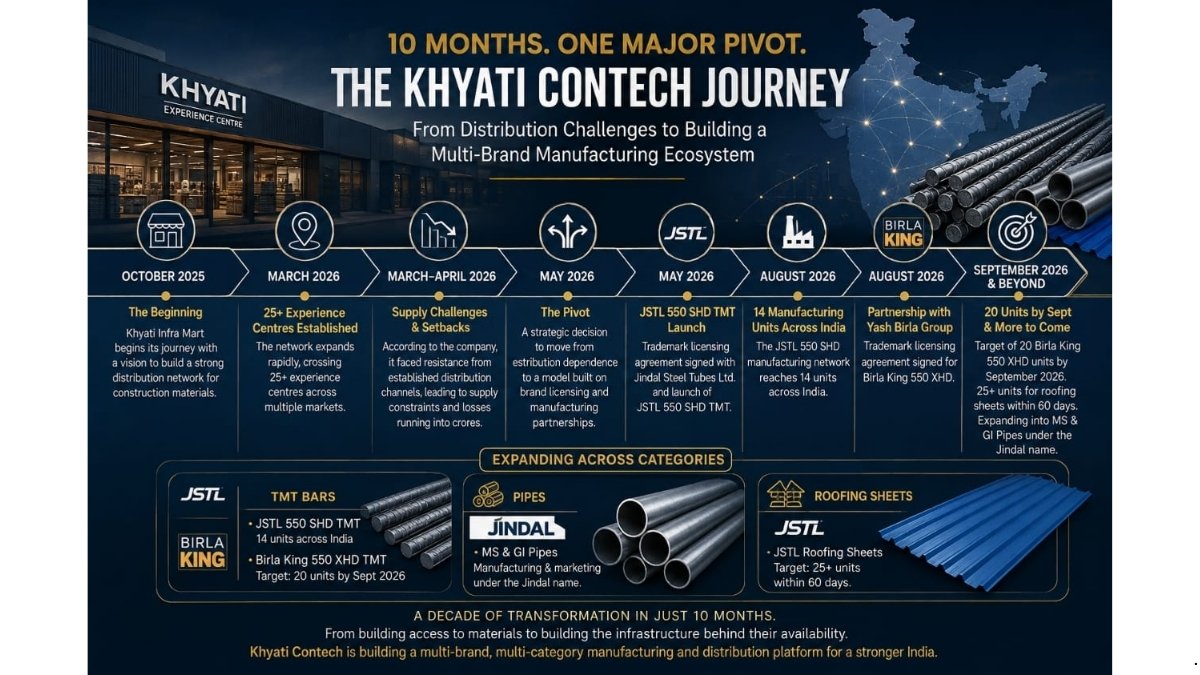
From a distribution-led start in October 2025 to 14 TMT manufacturing units and multiple new product categories in August 2026, the journey of Khyati Contech has been shaped as much by setbacks as by expansion.
New Delhi [India], August 27: In October 2025, when entrepreneur Avinash Bhatt began building Khyati Infra Mart, the plan was centred on a familiar construction-materials business model — create a network of experience centres and connect customers with established brands.
Five months later, the business had already crossed 25 experience centres.
But the rapid expansion brought with it a problem that would eventually change the direction of the company.
According to Bhatt, the growing network began facing difficulties in obtaining regular supplies from some established brands. He believes the company’s expanding distribution network was beginning to disrupt existing channel and distribution structures.
The result, he says, was a period of significant financial stress, with losses running into crores of rupees.
For Bhatt, the episode was not simply a financial setback. It raised a more fundamental question: could a distribution-led construction-material business scale if its supply remained dependent on decisions made by other brands and distribution networks?
The answer eventually led him to change the business model itself.
The March Turning Point
By March 2026, Khyati Infra Mart had already established more than 25 experience centres.
The network had given the company access to customers and local markets, but it also exposed the dependence that came with a conventional distribution model.
Bhatt says that while the company had invested in building the retail and market network, availability of branded products could not always keep pace with that expansion.
He describes the resulting losses as one of the most difficult phases of the business.
But instead of retreating from the sector, Bhatt began looking at the supply chain from the opposite end.
The question changed from “Which brands will supply Khyati?” to “Can Khyati build a business around brands and manufacturing partnerships of its own?”
That became the foundation for the next phase.
May 2026: The Manufacturing Pivot
The first major step came in May 2026.
Khyati entered into a trademark/brand licensing agreement with Jindal Steel Tubes Ltd. and subsequently launched JSTL 550 SHD TMT.
For the company, the agreement marked more than the launch of another TMT product.
It represented a change in the underlying business model.
Khyati was now attempting to combine licensed brands with manufacturing partners and its existing market infrastructure.
Instead of building its entire manufacturing capacity through one central facility, the company began developing a network of manufacturing units across different regions.
The logic was to create production capacity closer to markets while simultaneously using the distribution infrastructure developed during the Khyati Infra Mart phase.
From Distribution Network to Manufacturing Network
The transformation was rapid.
The company says the JSTL 550 SHD manufacturing network reached 14 units across India by August 2026.
The shift is notable because Khyati’s manufacturing journey followed its distribution expansion rather than preceding it.
The company first built the market network and then moved towards building the supply ecosystem behind it.
Its emerging model can broadly be described as:
Brand Licensing → Manufacturing Partners → Regional Production → Distribution → Market Expansion
For Bhatt, the manufacturing-partner approach is intended to reduce dependence on a single production location and improve the ability to serve different regional markets.
The Second Brand: Yash Birla Group
The company did not stop with JSTL.
In August 2026, Khyati Contech entered into another trademark/brand licensing agreement, this time with The Yash Birla Group, for Birla King 550 XHD.
The company is preparing to launch the Birla King brand through its manufacturing and distribution ecosystem.
It has announced a target of establishing 20 Birla King manufacturing units by September 2026.
The development changes the scale of the strategy.
Khyati is no longer building its manufacturing network around a single TMT brand. It is attempting to create a multi-brand TMT platform, with separate licensed brands operating through a common manufacturing and market-development framework.
Whether the aggressive timeline can be achieved—and whether the additional capacity can translate into sustainable market share—will be an important test for the company.
Moving Beyond TMT
The expansion in August also extended beyond reinforcement steel.
Khyati Contech entered into an agreement with Jindal Steel Tubes Ltd. for MS and GI pipes, with plans to manufacture and market the products under the Jindal name.
The move brings pipes into a business that initially started with construction-material distribution and subsequently moved into TMT manufacturing.
The company is also preparing to launch JSTL roofing sheets across India.
For the roofing-sheet business, Khyati has set a target of establishing more than 25 manufacturing units within 60 days.
If the plan progresses as targeted, roofing sheets could become another major manufacturing category within the company’s expanding portfolio.
The Cost of the Pivot
Behind these expansion numbers is a less visible part of the story.
The move into manufacturing was not initially presented as a long-planned transition from the beginning.
It emerged after the company encountered difficulties in the distribution business.
The losses incurred during the Khyati Infra Mart phase, according to Bhatt, became a catalyst for reassessing the company’s dependence on external brands.
For an entrepreneur who had already invested heavily in building more than 25 experience centres, the decision to change direction meant taking on another layer of operational complexity—manufacturing partnerships, quality processes, logistics, inventory and regional market development.
The pivot therefore involved more than changing products.
It meant changing the business architecture.
A Different Route to Scale
The conventional route in manufacturing is to invest in plants, build production capacity and subsequently develop distribution.
Khyati Contech’s emerging model is almost the reverse.
It started with customer access and distribution.
Then came the supply constraints.
The financial losses forced a strategic rethink.
Brand licensing followed.
Manufacturing partnerships came next.
And now the company is attempting to build multiple manufacturing networks across product categories.
The model is designed around three broad capabilities: access to established brands, distributed manufacturing and market reach.
The success of the strategy, however, will ultimately depend on whether the company can manage the complexity that comes with scaling all three simultaneously.
Ten Months That Changed the Business
The timeline illustrates the speed of the transformation.
October 2025: Khyati Infra Mart begins its construction-material distribution journey.
March 2026: The company reaches 25+ experience centres.
March–April 2026: Supply challenges and reported crores of losses trigger a rethink of the distribution-led model.
May 2026: Khyati enters into a trademark/brand licensing agreement with Jindal Steel Tubes Ltd. and launches JSTL 550 SHD TMT.
July–August 2026: The JSTL manufacturing network expands rapidly across India.
August 2026: The JSTL 550 SHD network reaches 14 manufacturing units, according to the company.
August 2026: Khyati enters into a trademark/brand licensing agreement with The Yash Birla Group for Birla King 550 XHD.
September 2026 target: 20 Birla King manufacturing units.
August 2026: The company enters into an agreement with Jindal Steel Tubes Ltd. for MS and GI pipes.
Next 60 days: Target of 25+ manufacturing units for JSTL roofing sheets.
What Comes Next for Khyati Contech?
The numbers make the transformation appear dramatic: from 25+ experience centres to 14 TMT manufacturing units in less than a year, followed by plans for additional manufacturing networks in Birla King, pipes and roofing sheets.
But manufacturing scale and commercial scale are not the same thing.
The company will now have to demonstrate that its growing production footprint can translate into consistent sales, efficient logistics, strong distribution relationships and sustainable profitability.
That could prove more challenging than establishing the manufacturing network itself.
For Bhatt, however, the direction appears to have been shaped by the experience of the previous ten months.
The journey began with the idea of creating a better distribution network.
A supply-chain setback changed that plan.
The losses forced a rethink.
The rethink led to brand licensing.
And the licensing strategy has now taken Khyati into manufacturing.
What began in October 2025 as a construction-material distribution venture is, by August 2026, evolving into an attempt to build a multi-brand, multi-product manufacturing and distribution platform.
The bigger question now is whether Khyati Contech can convert the speed of its manufacturing expansion into sustainable market share and profitability.
For Avinash Bhatt, the next phase will be less about proving that the company can expand quickly—and more about proving that it can make that expansion work at scale.
If you object to the content of this press release, please notify us at pr.error.rectification@gmail.com. We will respond and rectify the situation within 24 hours.
